

Advent treasure hunt clues for kids: how to run one clue a day in December
In short: An advent treasure hunt swaps the chocolate window for one clue each morning that leads to a small surprise somewhere in the house. Write all the clues in one evening, keep a master list, match the clue style to your child's age and save a longer trail for Christmas morning. Below: setup, clue styles for ages 4 to 10, 8 clues to copy and a plan for missed days.
An advent calendar is over in four seconds. A clue that sends a child from the pillow to the fridge to the boots by the door lasts a few happy minutes, and those minutes add up over 24 mornings. Here is how to set one up without it eating your December.
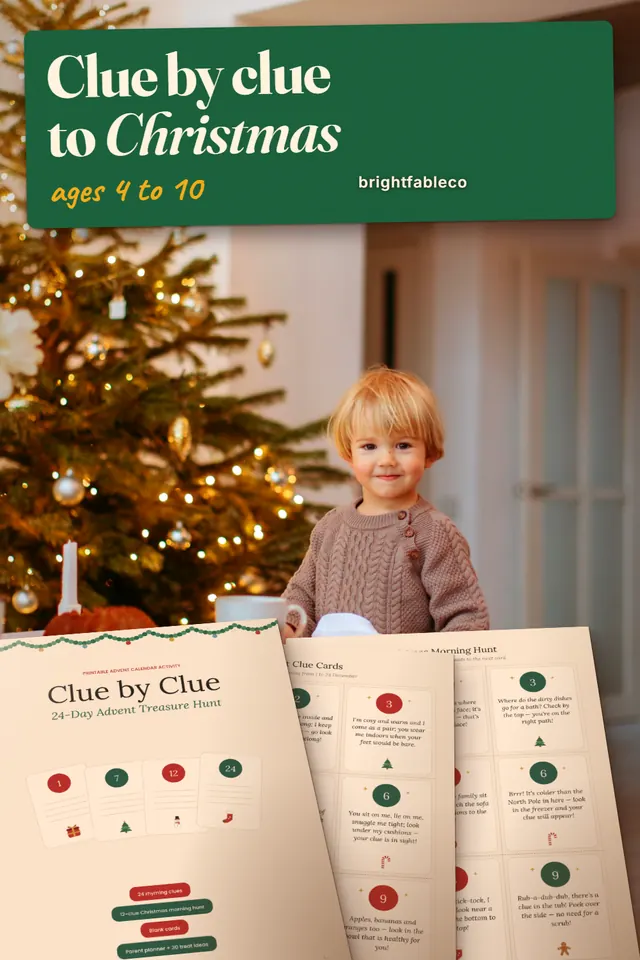
I like this idea for one reason above the others: it gives a child something to do with the excitement. The clue gets read, someone runs to the bathroom or the shoe rack, and for a moment the whole morning is a small game. It costs paper, a pen and a bit of planning.
The planning is where many of us give up, often in the first week, when we realise we are writing a rhyme at 11 pm. So this guide is mostly about the boring part: how to prepare once and then spend two minutes a night.
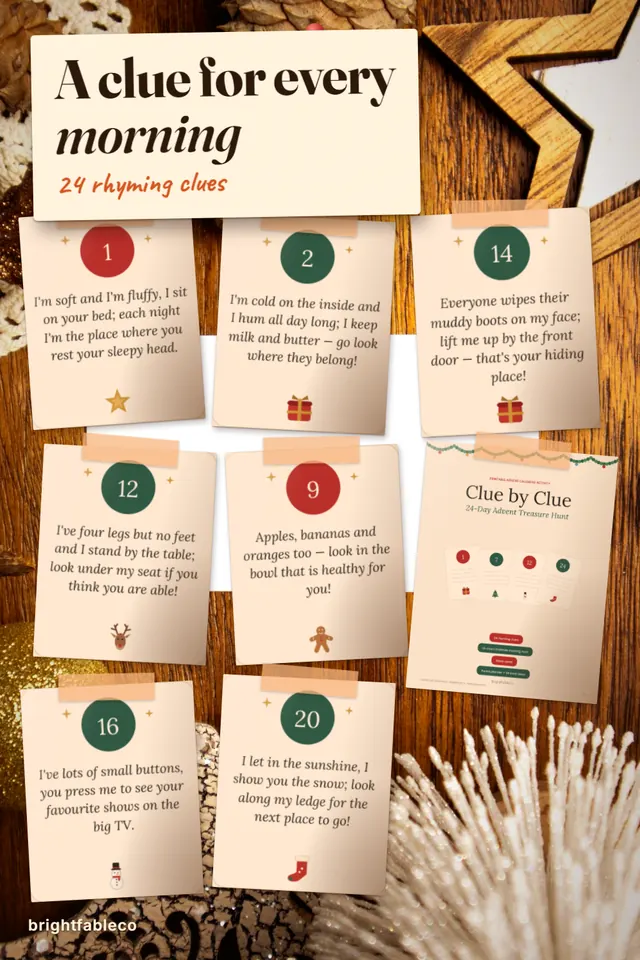
How an advent treasure hunt works
Every morning from 1 to 24 December your child finds one clue in the same starting spot: on the breakfast table, inside a slipper or taped to the bedroom door. The clue describes a place in your home without naming it. Your child works out the place, goes there and finds what you hid the night before: a small surprise, a note or an activity card.
Pick one starting spot and keep it for the whole month. Children like the routine of checking the same place, and you will not have to remember where you left today's clue.
Set it up in one evening
Give yourself about an hour, a cup of tea and a list of rooms. This is the order that saves the most time later.
- List 24 hiding places. Walk through the house and write down places your child can reach safely: the bread bin, the laundry basket, a coat pocket, the cereal box, under the doormat, a plant pot, the toothbrush cup. Leave out the oven, the stairs in the dark and anything high.
- Match places to dates. Put the quick, easy ones on school days and the far-away ones on weekends, when nobody is rushing to the car.
- Write all the clues now. One sitting, one style. If a rhyme will not come, write a plain riddle and move on.
- Number the cards and put them in order. An envelope per week works well. A shoebox with dividers works too.
- Make a master list. Date, clue, hiding place and surprise, on one sheet stuck inside a kitchen cupboard. On the morning a clue is found in the wrong room, this sheet will save you.
December fills up fast with school plays, work parties and visits. If you want help fitting the hunt into a crowded week, I wrote about planning your week with AI in 15 minutes, and the free Calm AI Prompt Pack has the same week-planning prompts.
Clue styles for ages 4 to 10
The same hunt can work for a four-year-old and a nine-year-old if you change how the clue is written.
Ages 4 and 5: nearly point at it
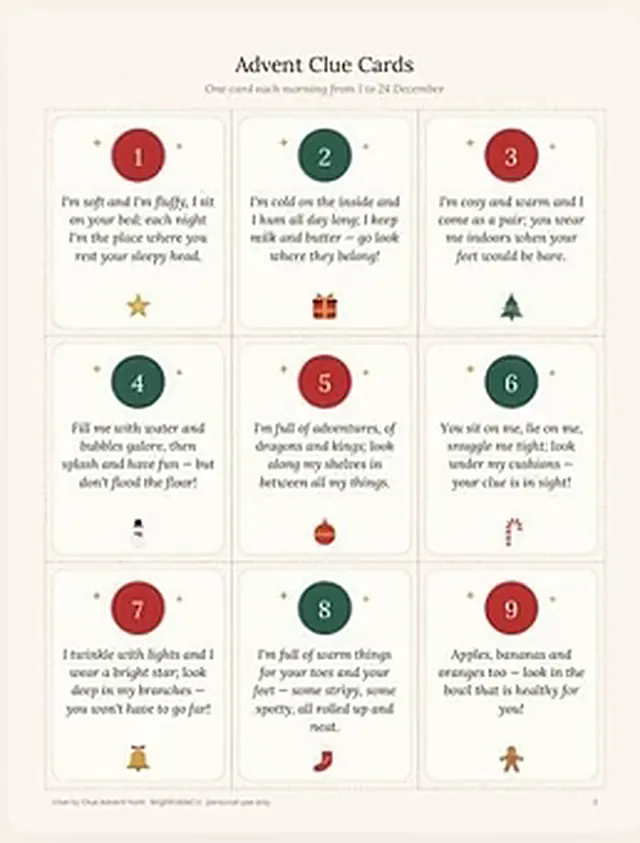
Read the clue aloud together. Describe what the object does and what it looks like, and keep it to one or two lines. "I am soft and round, you put your head on me at night" is perfect. A small drawing on the card helps children who do not read yet.
Ages 6 and 7: rhymes and one small twist
Children this age love finishing the rhyme before you do. Use two rhyming lines and describe the place from an unusual angle, for example what the object hears or feels. They can read many clues alone, so let them.
Ages 8 to 10: riddles and light codes
Older children get bored when clues are too easy. Add a riddle, a word with letters swapped, or a simple code where A=1, B=2. Once a week, make them earn the hiding place by solving two clues in a row. If you have children of different ages, let the older one read the clue to the younger one before solving their own bonus riddle.
8 advent clues you can copy
These are free to use. Answers are in brackets, so cover them before you print.
I hold the bread and keep it fresh,
lift my lid and look, no mess. (bread bin)Wipe your feet before you come in,
lift me up and look within. (doormat)I sit by the window and drink every week,
look under my leaves for the clue that you seek. (plant pot)Crunchy and sweet, I come in a box,
I wait in the cupboard, not with your socks. (cereal box)Brush, brush, brush, morning and night,
look in the cup where the brushes sit tight. (toothbrush cup)When it is cold you zip me up tight,
check in my pocket, left or right. (winter coat)Dirty socks and shirts climb in,
the clue is on top, not deep within. (laundry basket)3-15-21-3-8 (for ages 8+: a code where A=1. Answer: COUCH)
For more clue ideas and a 20-minute method that works backwards from the final hiding place, see the clue hunt section of our screen-free Christmas Eve guide.
What waits at the end of each clue
Twenty-four gifts is expensive and, honestly, a bit much. Mix three kinds of finds across the month:
- Small things: a sticker sheet, a new pencil, a hair clip, a clementine with a face drawn on it.
- Activities: a card that says "we bake cookies after school", "you choose tonight's story", "walk to see the lights", "breakfast for dinner".
- Notes: a joke, a riddle for the car, or one sentence about something your child did well this year.
I like activity cards most, because they turn into time together. Write them on the same day as the clues and check the family calendar first, so "ice skating" does not land on the evening of the school concert.
Busy days and missed mornings
You will miss a night. Everybody does. Two ways to keep the hunt alive:
- The double day. If you forgot to hide a clue, the next morning's card says "two clues today". Children usually see this as a bonus.
- Emergency cards. Write three spare clues for places that never move, such as the fridge or the front door, with an activity card instead of an object. On a chaotic evening you hide one in ten seconds.
Travelling over a weekend? Take the cards with you. A hotel room or a grandparent's flat has a pillow, a wardrobe and a bathtub, and a new place makes the hunt feel fresh.
A longer hunt for Christmas morning
After 24 single clues, Christmas morning can be a full trail: one clue leads to the next, through the house, ending at the tree or the first present. Ten to twelve clues is a good length for the 4 to 10 age range. It keeps everyone busy for a while, and it gives the adults a few more minutes with their coffee. If you have a group of older children at home on Christmas Eve, the night before can have its own game; our guide to Christmas party games has options by group size and time.
If you would rather not write 24 rhymes
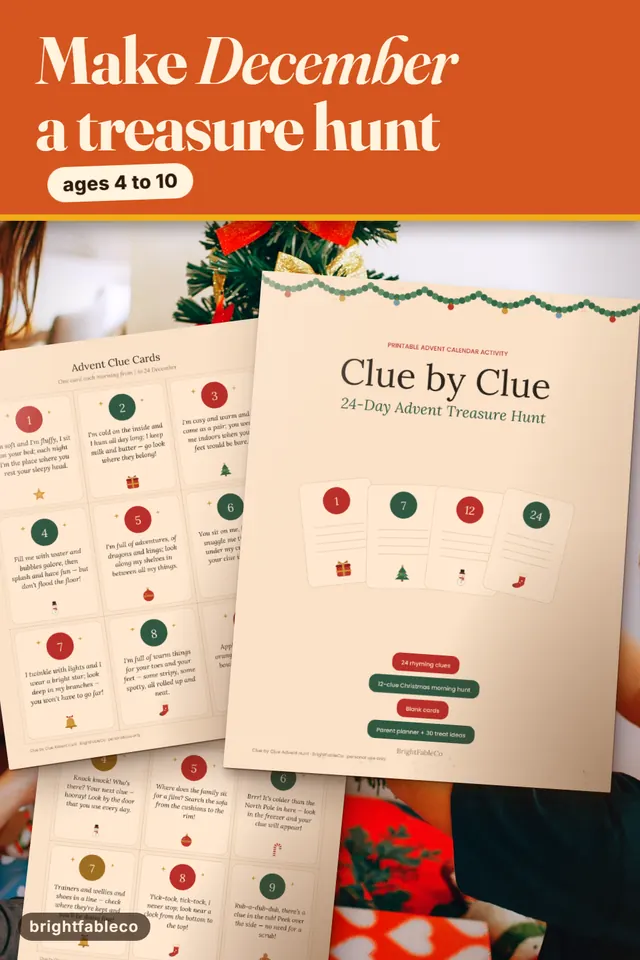
Writing the clues yourself is the free route, and the steps above are enough. If December is already full, BrightFableCo, our Etsy shop, has a printable advent treasure hunt for kids with the writing done. It has 24 rhyming clue cards, one for each December morning, plus a 12-clue Christmas morning hunt for the finale. There are 9 blank clue cards for hiding places that only your home has, and a parent planner that lists every answer and gives 30 treat ideas. It is made for ages 4 to 10, with hiding spots such as the pillow, fridge, boots and bookshelf, and the clues are written so you can read them together with little ones. You print it at home and cut the cards; nothing is shipped.
For children aged 8 and up who want something bigger on Christmas Eve, the shop also has The Missing Sleigh Key, a printable escape room for 2 to 8 players that runs 45 to 60 minutes.
FAQ
What is an advent treasure hunt?
It is an advent calendar in clue form. Each morning from 1 to 24 December your child gets a short clue, often a rhyme, that leads to a hiding place in the house where a small surprise or the next note is waiting.
What age is an advent treasure hunt for?
Roughly ages 4 to 10. Children of 4 or 5 need very obvious clues read aloud by an adult; 6 and 7 year olds enjoy rhymes; children of 8 to 10 can handle riddles, wordplay and simple codes.
Does every clue need a gift at the end?
No. Many days can end with a note, a joke, a sticker or an activity such as baking or a walk to see the lights. Keep a few small treats for the days that need a lift.
How long does it take to set up each night?
About two minutes if you write all the clues in advance. Each evening you hide one card and, if you use one, the small surprise. Writing all 24 clues takes most people one evening.
Is there a printable advent treasure hunt?
Yes. The BrightFableCo advent treasure hunt is an 11-page printable PDF with 24 rhyming clue cards, a 12-clue Christmas morning hunt, 9 blank cards and a parent planner with every answer and 30 treat ideas, for ages 4 to 10.